Thursday, March 24, 2011

IRP Blog Post 12

"White Inside"


This section of The Adventures of Huckleberry Finn explores the nature of race and humanity. When Tom is shot by farmers, Tom kindly mentions that he be brought to a doctor, proving to Tom and Huck that Jim has a sense of selflessness, contrary to popular opinions.
"I knowed he was white inside, and I reckoned he'd say what he did say- so it was all right, now, and I told Tom I was agoing for a doctor" (Twain 284).
This passage may indicate that there is humanity in everyone, even the lowly slave.

IRP Blog Post 11

Unintended Consequences


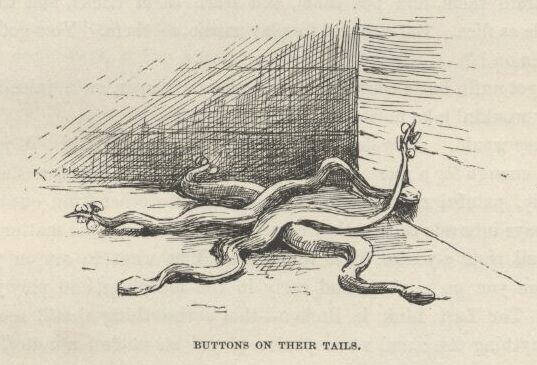
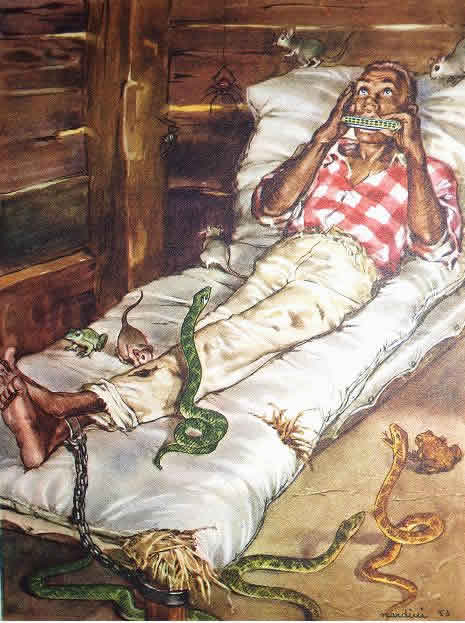
As part of their elaborate scheme of rescuing Jim, Tom Sawyer and Huckleberry Finn gather numerous rats spiders, frogs, caterpillars, and even snakes. They even wanted to get a hornet's nest. They make the mistake of storing the critters inside of Aunt Sally's house. Naturally, all of these animals escaped from their storage locations.
"We didn't half tie the sack, and they worked out, somehow, and left. But it didn't matter much, because they was still on the premises somewhere" (Twain 274).
The lesson of the experience is that you should watch where you store things because they might very well crawl away, as Huckleberry Finn found out the hard way.

IRP Blog Post 10

Practicality vs. Novelty


Huckleberry Finn and Tom Sawyer begin to free Jim by using knives because this is apparently the way that it is done in books. After making little progress, they realize that it is simply much more realistic to use pickaxes.
"It ain't no use, Huck, it ain't going to work. If we was prisoners it would , because then we'd have as many years as we wanted and no hurry...But we can't fool along, we got to rush; we ain't got no time to spare" (Twain 254).
 The futility, however, does not stop here. Tom tells Nat that he needs to bake a witch pie for Jim in order to get rid of the witches. He plans to bake a rope ladder into the pie, even though it is completely unnecessary.

Thursday, March 10, 2011

IRP Blog Post 9

Rescuing Jim


Huck and Tom conspire to free Jim from his prison, but they are saddened that Jim's escape would be too easy. They complain that Uncle Silas would give the prison key to anyone and that Jim is only chained to the leg of a bed. Why the disappointment? They, especially Tom, see honor in a difficult escape. Tom proposes to "invent all the difficulties".
"No; the way all the best authorities does , is to saw the bedleg in two, and leave it just so, and swallow the sawdust, so it can't be found... nothing to do but hitch your rope ladder to the battlements, shin down it , break your leg in the moat" (Twain 246).
Does difficulty make something more honorable? You make the call.

IRP Blog Post 8

"Human beings can be awful cruel to one another"


In this section of The Adventures of Huckleberry Finn, Huck reunites with Tom Sawyer. After having dinner at the Phelps house, the boys see a mob of people.
"We jumped to one side to let them go by; and as they went by, I see they had the king and duke astraddle of a rail... they was all over tar and feathers, and didn't look like nothing in the world that was human" (Twain 238).
 Huck points out the often unfairness of life when he says, "Human beings can be awful cruel to one another".

IRP Blog Post 7

Theme: The Pervasiveness of Racism

The use of the n-word is widespread in The Adventures of Huckleberry Finn. It has recently created controversy with a new edition of this book that eliminates such language. While certainly politically incorrect, the racists mindsets in the book serve as a window into times gone by. One example occurs when, Huck is talking about a steam boat explosion with Sally.
"'It wasn't the grounding - that didn't keep us back but a little. We blowed out a cylinder-head.' 'Good gracious! Anybody hurt?' 'No'm. Killed a nigger.' 'Well, it's lucky; because sometimes people do get hurt'" (Twain 228).
Obviously, this kind of sentiment is viewed today as atrocious. Might there be any ideas in our society that will be viewed the same way 150 years from now?

Friday, February 25, 2011

IRP Blog Post 6

Fog not only clouds vision but also the mind


Huckleberry Finn and Jim continue to travel down the Mississippi River when a deep fog approaches their raft. They are unable to see anything in front of the raft, so they do not paddle. Suddenly, the raft smashes into an island on the river. Huck is completely lost as his senses deceive him as he swings in both directions across the bank of the river.
"I couldn't tell nothing about voices in a fog, for nothing don't look natural nor sound natural in a fog" (Twain 86).
 When Huck returns to the raft, he lays down underneath of Jim. Under the cover of the fog, he attempts to trick Jim into believing that he had been asleep the entire time. The fog clouded Jim's mind. Huck said to Jim:
"What's the matter with you, Jim? You been a drinking?...Well, then, what makes you talk so wild?" (p88).

IRP Blog Post 5

The Dauphin

Huckleberry Finn wants to go after a king. After giving up on King Solomon, or Solermunis, as he is called, Huck wants to go after a new king. He is convinced that the son of the late Louis the Sixteenth, the dauphin, moved to America. They want to track him down and keep him company. Many people, myself included, like to look for those that are better than ourselves and imagine that they exist.

Thursday, February 24, 2011

IRP Blog Post 4

The Boat


Huckleberry Finn and Jim move to sabotage a boat belonging to some looters who were plundering a steam boat. At the last minute, Huck finds sympathy for the robbers.
"Then Jim manned the oars, and we took out after our raft. Now was the first time that I begun to worry about the men - I reckon I hadn't had time to before. I begun to think how dreadful it was, even for the murderers, to be in such a fix (Twain 75)."
It seems often that characters do things that they later regret and seek to re-do. This is an intrinsically human characteristic that Twain gives to Huckleberry Finn. I have often felt second thoughts about many of my own actions.

Motorcycle Diaries Section 2

You    Che    5 Tweets    Obstacles


1. You should probable look before you shoot.
2. Why use a motorcycle?
3. You guys are hardly experts in leprosy!
4. Don't be so quick to blame one woman's misfortune on a 'system'
5. You got lucky on that boat.

Thursday, February 10, 2011

IRP Blog Post 3

Pap

(MEDIA: Watch a 1.5 minute animated video on Huck's meeting with his dad here)

Huck's father is first introduced to the reader when Huck finds him sitting in his room. Immediately, the reasons for Huck living with the Widow become abundantly clear. Pap is a gruff man who instantly becomes mad at Huck for merely wearing starched clothes that his nicer than his own. Pap is angered that Huck is being raised to a better standard than his own father. He is angry that Huck goes to school and is learning to read. Pap continuously promises that he will tan (beat) Huck. Pap later ends up in jail for drunkenness. For a short time, Pap becomes clean after being reformed by the judge and dresses nicely, encouraging people to shake his hand. That night, however, pap went back on his old ways and "got powerful thirsty". The judge conceded, "He reckoned a body could refor the ole man with a shotgun, maybe, but he didn't know no other way" (Twain 24). It is clear that Pap is a terrible man with no real redeeming quality, but it is possible for the reader to sympathize with his situation.

IRP Blog Post 2

Jim


Jim is one of Miss Watson's slaves, referred to in The Adventures of Huckleberry Finn using the n-word. This reflects the social attitudes of the time period that Mark Twain portrayed, the 1830s and 40s in the South. Jim is shown as being extremely unintelligent. In Chapter 4, he is shown relying on a hairball that was found in "the forth stomach of an ox" for advice. Huck thinks that he sees his father's tracks in the snow so he asks Jim for advice from the hairball. Jim mentions that there would be two angels - one black and one white. Huck goes to his room that night and sees his father, "There sat pap, his own self" (p 19).

IRP Blog Post 1

Tom Sawyer's Gang

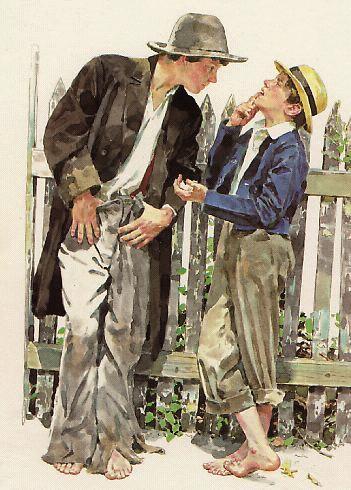
Early in The Adventures of Huckleberry Finn, Huck Finn sneaks out of his home where he meets his longtime friend Tom Sawyer. They, and several other boys, form a band of robbers called "Tom Sawyer's Gang".
"So Tom got out a sheet of paper that he had wrote the oath on, and read it. It swore every boy to stick to the band and never tell any of its secrets" (Twain 8).
The boys make their way to a cave, and it becomes clear that they are not really a band of murderous criminals as they may think. Tom Sawyer suggests that the gang "randsomed" people from their cave; however, none of the boys seem to know what the word ransom means. The boys also showed that they have some reverence for religion.
"Ben Rodgers said he couldn't get out much, only Sundays, and so he wanted to begin next Sunday; but all the boys said that it would be wicked to do it on Sunday, and that settled the thing" (p 10).
The Tom Sawyer Gang only stays together for a few months, they realize that their is not much purpose in the gang.

Thursday, February 3, 2011

3rd MP Independent Reading Book

The Adventures of Huckleberry Finn
By Mark Twain

180 Degrees South Reflection

" The best journeys answer questions that in the beginning you didn't even think to answer."

The film shed light on the fact that the journey can often be more important than the destination. Valuable lessons are often learned over the course of a journey, and Jeff seemed to learn a few of these. I would disagree somewhat with his analysis, however. They state in the film that we need to stop making 'progress' and take a step back from the cliff. Innovation and progress has been important in allowing people to live longer, better lives. I understand the importance of open spaces and wilderness, but there needs to be some kind of balance.

They seem to say that the land should be open and free, but this is the essence of the problem. If individual landowners had full property rights over their land, and the water, things could be run as they see fit.

Wednesday, January 5, 2011

IR Blog Post 4 - Autoblog

Retirement: Grand Marquis last Mercury off the line

Mercury was originally part of Ford Motor Company in 1939 as a middle of the line car between the regular Fords and Lincoln luxury cars. With recent financial difficulties at Ford, the company has been forced to cut back its lineup. In 2011, Mercury will officially cease to exist. The last Mercury rolled off the line in a Grand Marquis. The basic design of the vehicle has been in use for over 30 years - since the late 1970s and is popular with seniors. Will this decision help Ford compete with foreign competition? Will Ford be able to replace the niche market that once bought Murcury vehicles? Viknesh Vijayenthiran from motorauthority.com says that it is sad to see the historic brand go but that it may be a necessary move for Ford.

IR Blog Post 4 - The Blaze

Cop Gives Ticket After Helping Them Rush to Hospital for Baby Delivery

Angela Couglin was ready to give birth to her son so hew husband, John, drove them to the hospital. He reached speeds of over 100 mph, but called 911 to inform police of the situation. The car was escorted by a New Hampshire State Trooper. No sooner than the baby was born, however, the troop wrote a speeding ticket to the family. He said, "Congratulations on your son but I'll see you in court." The nurse said that there could have been damage to the baby if he had been delivered any later. Was it 'right' for the officer to issue a ticket because they endangered the lives of others on the road? Is it justified to endanger the lives of others on the road in a situation like this (medical emergency)? A blogger on ridelust.com says that if he were in that situation, the pedal would have been on the floor. I agree.

IR Blog Post 4 - New York Times Books

Publisher Takes n-word out of "Adventures of Huckleberry Finn"

In the book. The n-word is used a total of 219 times. It reflects the social attitudes of an era gone by. Now, the publisher NewSouth Books plans to release a new edition of the book where the n-word has been replaced by the word "slave". The move was first suggested by an English professor at Auburn University who always hesitated before reading the word aloud. Could this move to sanitize books literally change the lessons of history? Will this move of political correctness spread to other books? Keith Staskiewicz from Entertainment Weekly says that the move is good because it will expand access to the book across wider audiences.